Good media content has the power to enrich our lives. Its effectiveness is becoming more and more important in a wide variety of fields, such as industry, education, culture, and entertainment. Expectations of its use in the general public are also increasing. Although the word content might be used to refer to a single image or music we use the broader definition of content.
Content is provided to people through adequate output devices such as displays, such that people derive profound pleasure by interacting with it through an appropriate input device. Through these interactions with content on a computational device people can enhance their hedonistic feeling of satisfaction, happiness and excitement. Moreover, content is not always enjoyed alone but often in the company of others (e.g., friends, family, and so on) simultaneously. In these cases, it is necessary to consider the “environment” in which groups of people enjoy the content and “atmosphere” which is generated by the “environment.” Good interactive content has the potential to calm the “atmosphere” and in the process will often make the people in the environment more happy and friendly.
Thus, we focus on non-traditional content areas other than movies, music, and games, conducting comprehensive research on a variety of interactive content which creates new value through interactions with humans, by considering the atmosphere including the content and human. In this context, the focus of our group is in researching new and innovative techniques to interact with novel forms of content with the goal of enhancing the impact, effectiveness and hedonistic feelings of the content to improve and enrich people’s lives. We focus on non-traditional contents along side more traditional content like movies, music and games.
Topics
- September 28, 2026
Prof. Yang Jianfei, the NTU PI for the project “Safeguarding Elderly Users in Embodied Task Planning with LLM,” which was selected by the “Tohoku University–NTU Joint Research Fund” established to promote and encourage joint research between Nanyang Technological University (NTU) in Singapore and Tohoku University, visited us and gave a lecture titled “Beyond Language: Teaching Robots to Understand How Humans Communicate.”
- September 18, 2026
Prof. Benjamin Watson from NC State University in the U.S. visited us and gave a talk titled “Latency: Its Effects on Interaction and gameplay, and How to Reduce It”.
- September 7, 2026
We attended the 14th International Conference on Affective Computing and Intelligent Interaction (ACII 2026), which was held in Mexico on September 7th – 10th, 2026.
We hosted the Multilingual and Multimodal Affective Computing Workshop & Challenge (MMAC 2026).
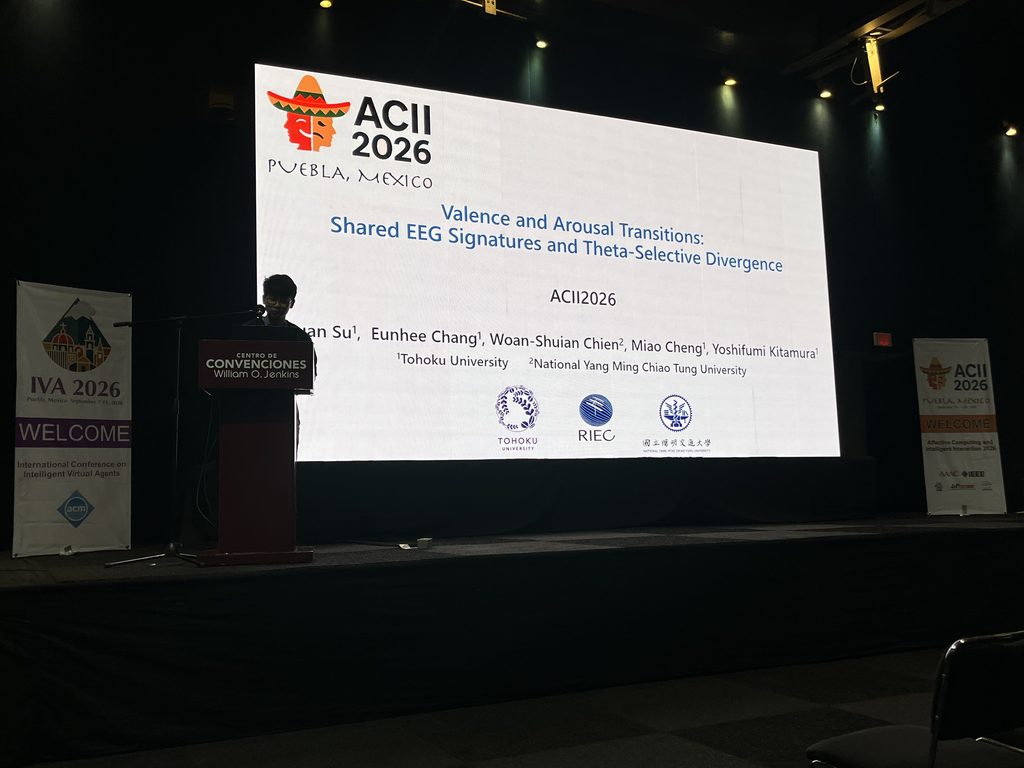
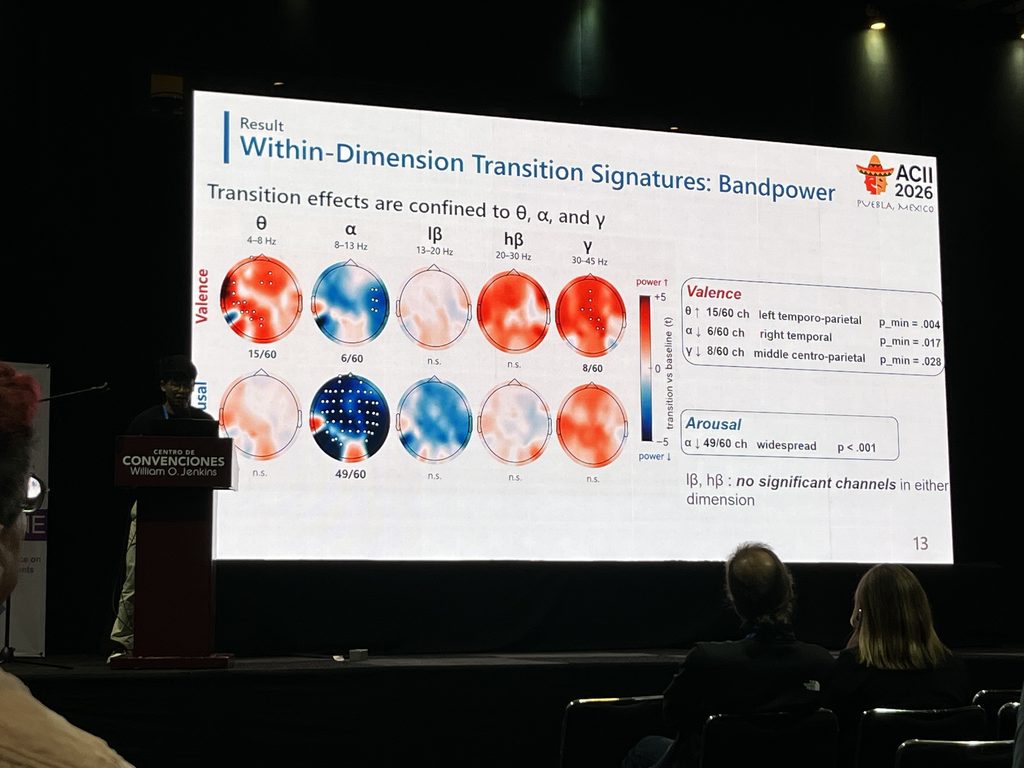
Participants were invited to use our DIEM-A dataset (Diverse Intercultural E-Motion Database of Asian Performers) for emotion recognition from human motion. Two papers were selected for Best Performance and Best Explainability. More information is available on the MMAC 2026 website• We presented a paper on EEG features of valence and arousal transitions:
Huan Su, Eunhee Chang, Woan-Shiuan Chien, Miao Cheng, and Yoshifumi Kitamura. “Valence and Arousal Transitions: Shared EEG Signatures and Theta-Selective Divergence.” In 14th International Conference on Affective Computing and Intelligent Interaction (ACII ’26)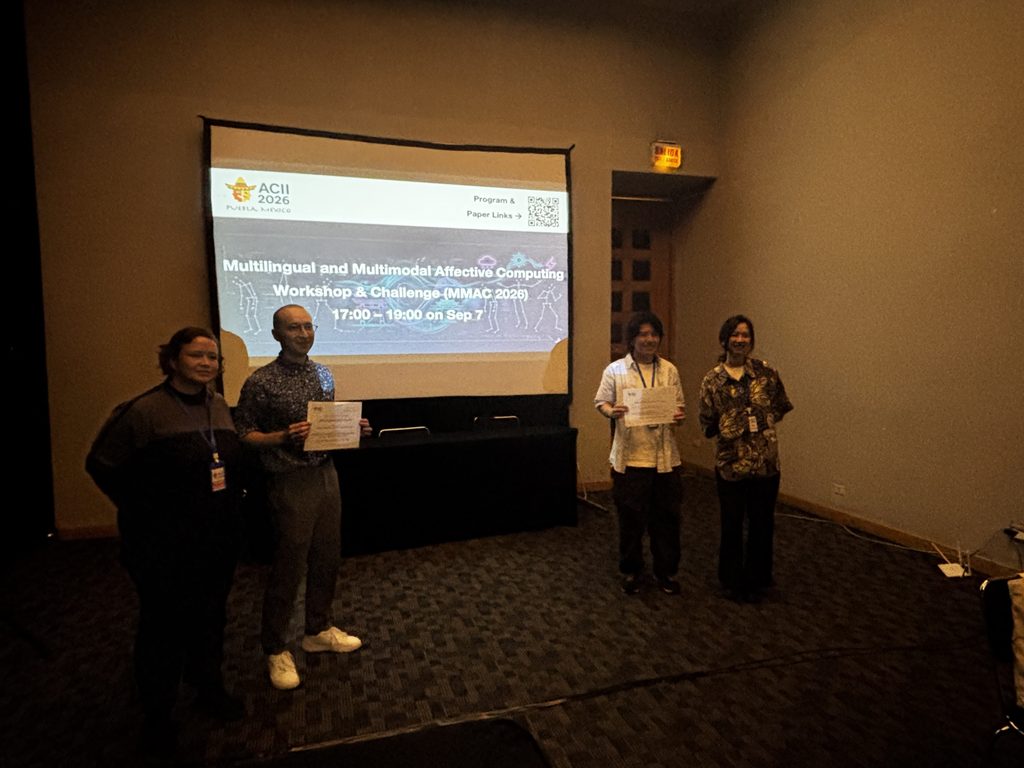
- September 25, 2026
We will host the ACM Symposium on Virtual Reality Software and Technology (VRST) 2026 from November 16 to 18 at the Global Connect Hub – Atelier Q∞, Research Institute of Electrical Communication, Tohoku University, where our laboratory is located.

- September 16, 2026
Second-year students from Miyagi Prefectural Ishinomaki High School visited the Research Institute of Electrical Communication and toured our laboratory. During their visit, the students experienced motion capture and VR technologies.
For more details, please see the article on the RIEC website.
- August 28, 2026
Prof. Zheng Zhi from the University of Notre Dame Visited our laboratory and gave a lecture entitled “Physical AI for Supporting Patients with Alzheimer’s Disease.”
In the lecture, Prof. Zheng introduced the research on Physical AI for supporting patients with Alzheimer’s disease (AD).


