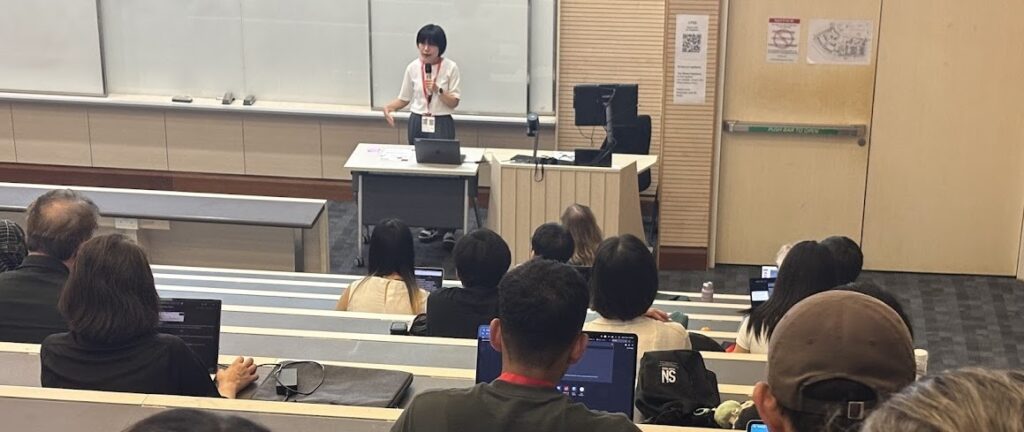
Prof. Yang Jianfei, the NTU PI for the project “Safeguarding Elderly Users in Embodied Task Planning with LLM,” which was selected by the “Tohoku University–NTU Joint Research Fund” established to promote and encourage joint research between Nanyang Technological University (NTU) in Singapore and Tohoku University, visited us and gave a lecture titled “Beyond Language: Teaching Robots to Understand How Humans Communicate.”
September 18, 2026
Prof. Benjamin Watson from NC State University in the U.S. visited us and gave a talk titled “Latency: Its Effects on Interaction and gameplay, and How to Reduce It”.
September 7, 2026
We attended the 14th International Conference on Affective Computing and Intelligent Interaction (ACII 2026), which was held in Mexico on September 7th – 10th, 2026.
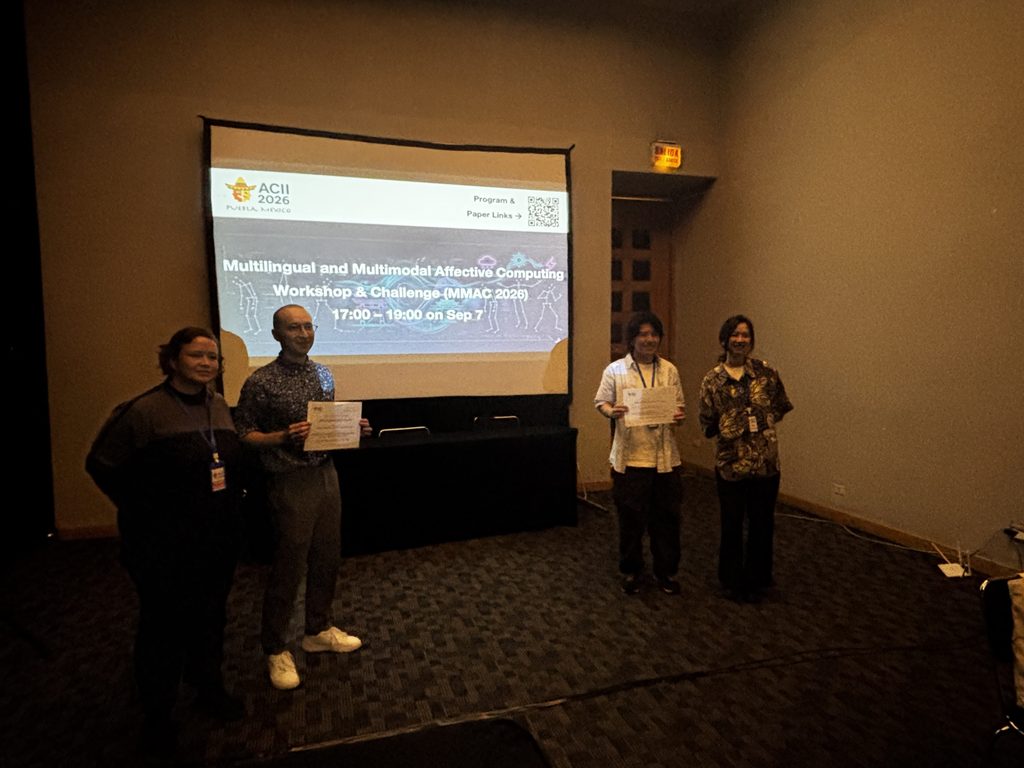
We hosted the Multilingual and Multimodal Affective Computing Workshop & Challenge (MMAC 2026).
Participants were invited to use our DIEM-A dataset (Diverse Intercultural E-Motion Database of Asian Performers) for emotion recognition from human motion. Two papers were selected for Best Performance and Best Explainability. More information is available on the MMAC 2026 website
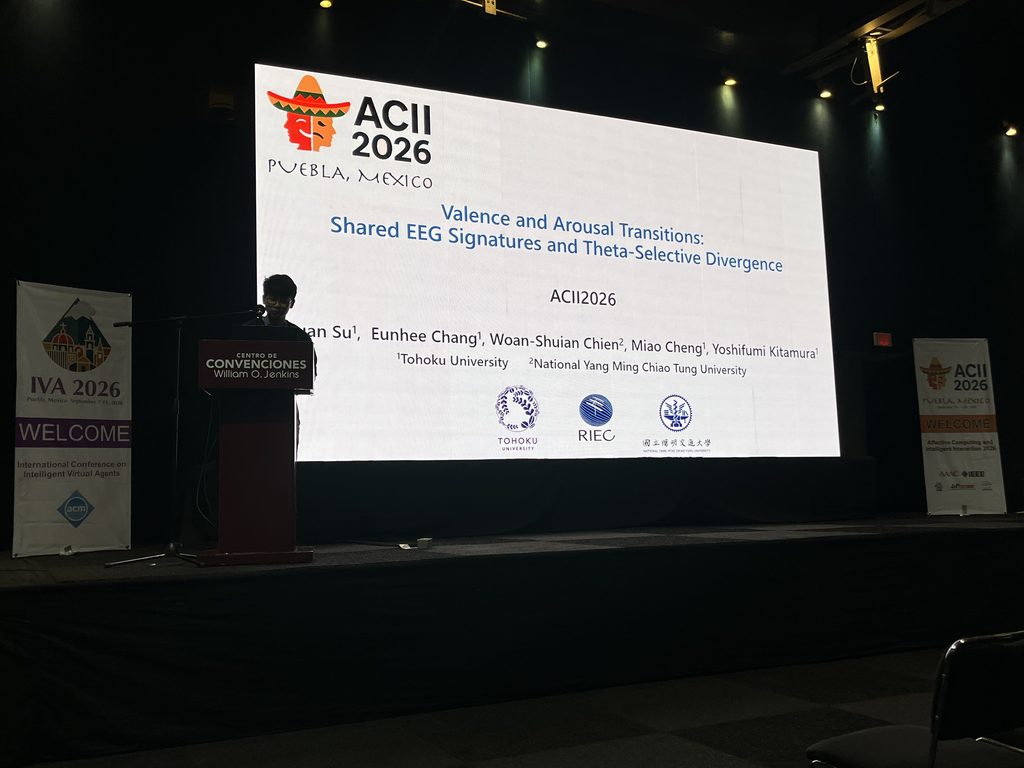
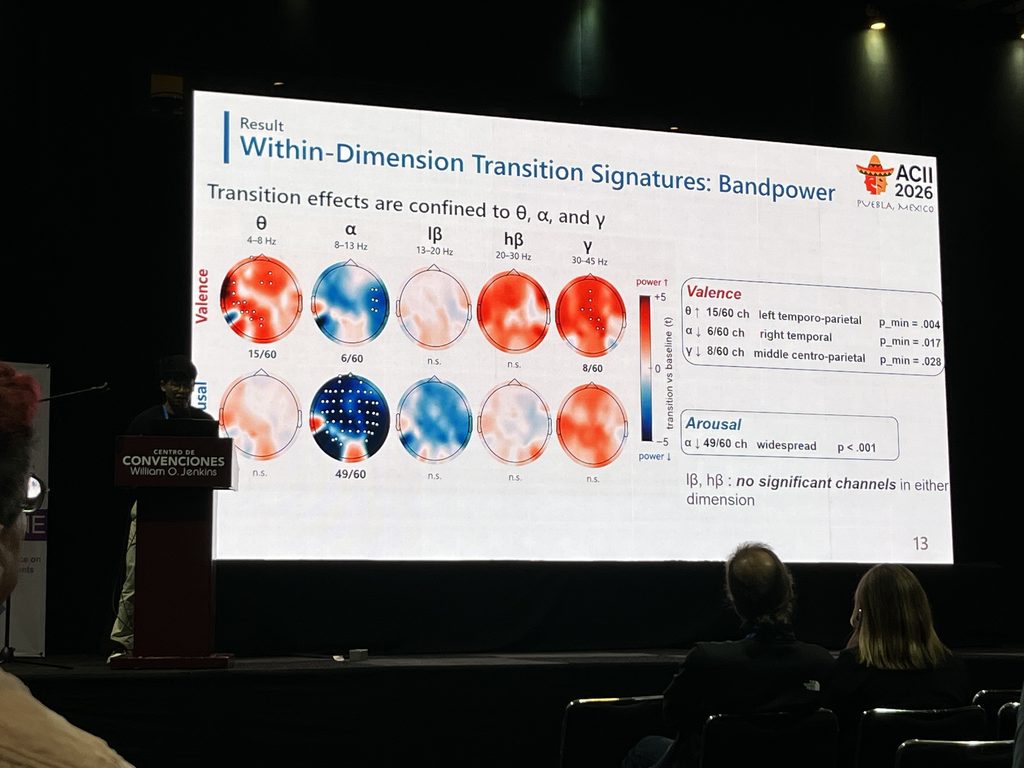
• We presented a paper on EEG features of valence and arousal transitions:
Huan Su, Eunhee Chang, Woan-Shiuan Chien, Miao Cheng, and Yoshifumi Kitamura. “Valence and Arousal Transitions: Shared EEG Signatures and Theta-Selective Divergence.” In 14th International Conference on Affective Computing and Intelligent Interaction (ACII ’26)


September 25, 2026
We will host the ACM Symposium on Virtual Reality Software and Technology (VRST) 2026 from November 16 to 18 at the Global Connect Hub – Atelier Q∞, Research Institute of Electrical Communication, Tohoku University, where our laboratory is located.

September 16, 2026
Second-year students from Miyagi Prefectural Ishinomaki High School visited the Research Institute of Electrical Communication and toured our laboratory. During their visit, the students experienced motion capture and VR technologies.
For more details, please see the article on the RIEC website.
August 28, 2026
Prof. Zheng Zhi from the University of Notre Dame Visited our laboratory and gave a lecture entitled “Physical AI for Supporting Patients with Alzheimer’s Disease.”
In the lecture, Prof. Zheng introduced the research on Physical AI for supporting patients with Alzheimer’s disease (AD).
August 14, 2026
Our paper, which was presented at ACM Designing Interactive Systems (DIS) 2026 and received an Honorable Mention Award, was featured in JST Science Japan.
AI and AR help preserve the art of ikebana — New training system aims to make ikebana’s relaxation and mental benefits accessible to all
https://sj.jst.go.jp/news/202608/n0814-02k.html
July 3, 2026
As a part of the Tohoku University STEM Summer Program 2026 (TSSP2026), approximately 20 students from the United States and the United Kingdom visited our laboratory.
After a lecture by Professor Kitamura, our laboratory members guided the visitors through the lab and introduced our research with demonstrations.
The visit concluded with an engaging discussion and exchange of ideas between the students and our lab members.
June 25, 2026
We welcomed Dr. Toshikazu Kuroda and Dr. Takeshi Ogawa from the Dynamic Brain Imaging, Cognitive Mechanisms Laboratories, Brain Information Communication Research Laboratory Group, Advanced Telecommunications Research Institute International (ATR), who gave research talks at our laboratory.
The lectures were titled “Behavior: How to Conceptualize it, Measure it, and Analyze it” and “Development of a brain-state prediction method based on EEG-fMRI simultaneous measurement and its application”.
They also visited our laboratory facilities, where we had a valuable opportunity to exchange ideas and discuss various research topics.
June 23, 2026
We welcomed Distinguished Professor Chia-Wen Lin from National Tsing Hua University, who gave a lecture on the topic of “AI-Powered IC Design”.
In the lecture, Professor Lin introduced cutting-edge technologies for AI-driven IC design and manufacturing support, as well as the latest research achievements toward their practical applications.
Professor Lin also discussed the potential of next-generation EDA technologies enabled by the fusion of AI and semiconductor design.
June 16, 2026
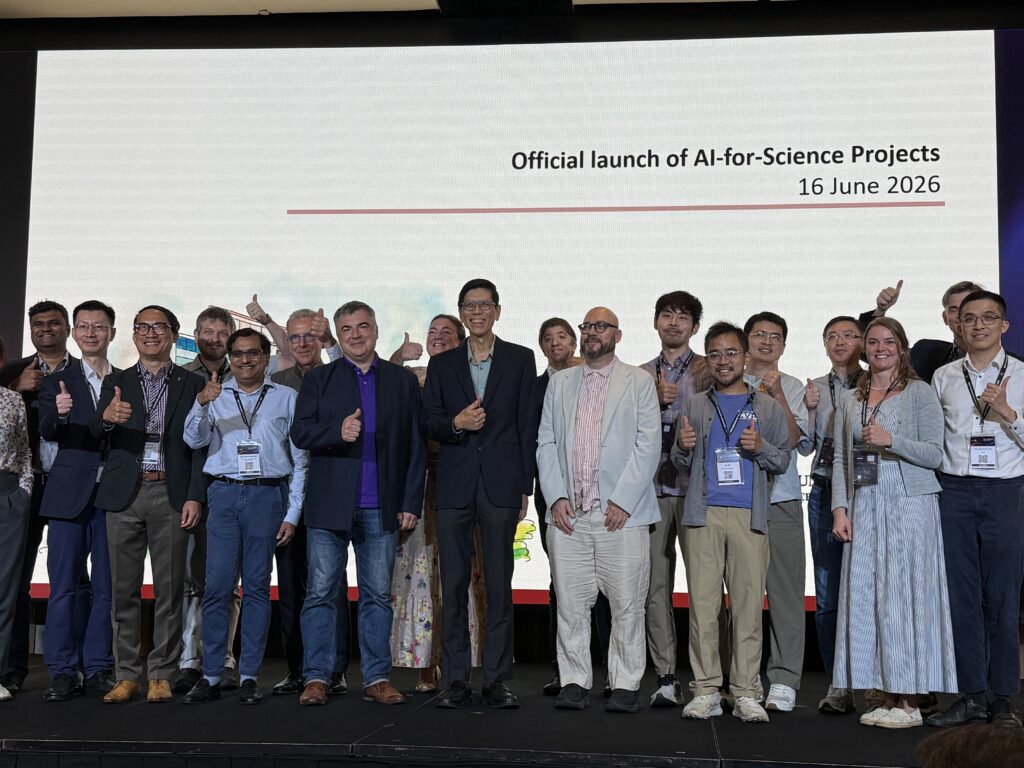
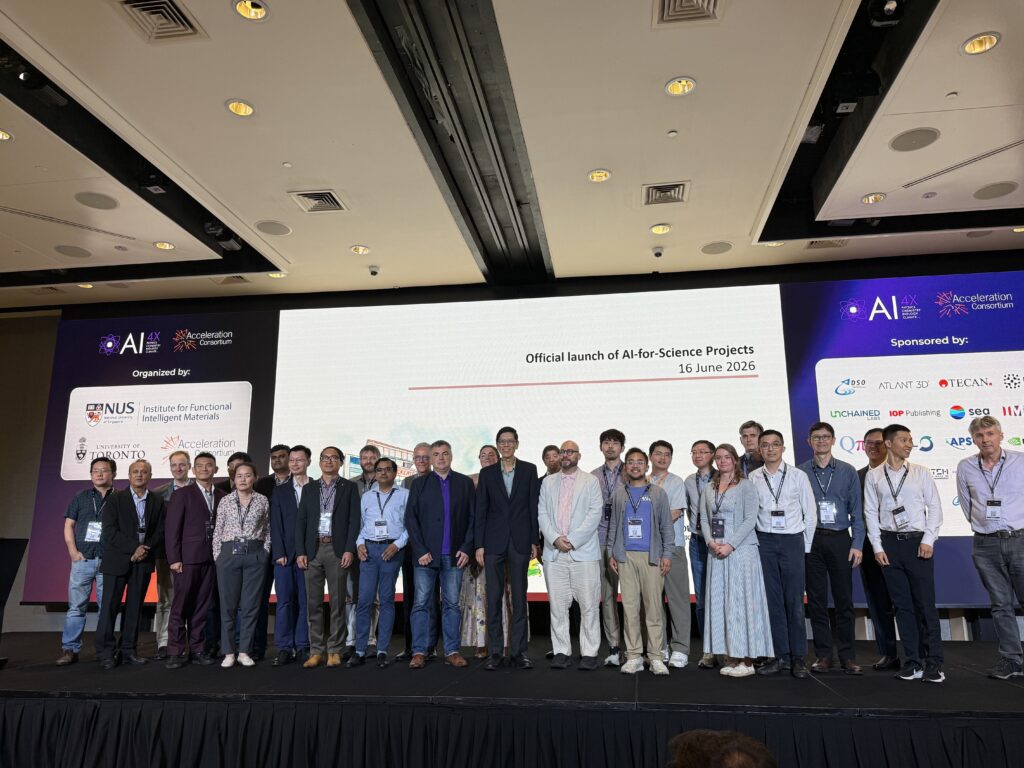
Assistant Professor Lin Gu Invited to AI4X Accelerate Conference 2026 as an AI for Science Awardee
Assistant Professor Lin Gu has been invited to participate in AI4X Accelerate Conference 2026 as one of the awardees of Singapore’s AI for Science (AI4S) initiative.
AI4S is a landmark S$120 million (approximately ¥14 billion) national initiative spearheaded by the National Research Foundation to transform scientific discovery through artificial intelligence. The program brings together leading AI researchers and domain experts from top institutions in Singapore and around the world to tackle major scientific challenges through interdisciplinary collaboration.
Dr. Gu is a co-lead investigator of an AI4S project focused on developing foundation models and world models for fusion plasma science. By integrating large-scale AI models with scientific data and domain knowledge, the project aims to advance the understanding, prediction, and control of fusion plasmas while accelerating the process of scientific discovery.


June 13-17, 2026
Research Fellow Xiyue WANG and M2 student Akira Murakami each gave oral presentations on two papers accepted for ACM Designing Interactive Systems (DIS) 2026, held in Singapore. Xiyue WANG’s paper received the Honorable Mention Award.
- Xiyue Wang, Zeynep Eda Altintop, Derek Kirschbaum, Yoshifumi Kitamura, Miao Cheng, Chiahuei Tseng. HanaARrange: Designing an Augmented Reality Support System for Daily Ikebana Practice and Well-being
- Akira Murakami, Kazuyuki Fujita, Yuki Onishi, Yoshifumi Kitamura. OrigamiWalls: A Shape-Changing Robotic Partitioning System for Diverse Spatial Reconfigurations

Dr. Xiyue WANG also gave a demonstration of the content of the paper she presented.
June 11, 2026
A ceremony was held to celebrate the completion of the Global Connect Hub – Atelier Q∞, where our laboratory is located.
- We were featured in the Kahoku Shimpo https://kahoku.news/articles/20260611khn000059.html
- We were featured in the Nikkei https://www.nikkei.com/article/DGXZQOCC119CR0R10C26A6000000/
June 5, 2026
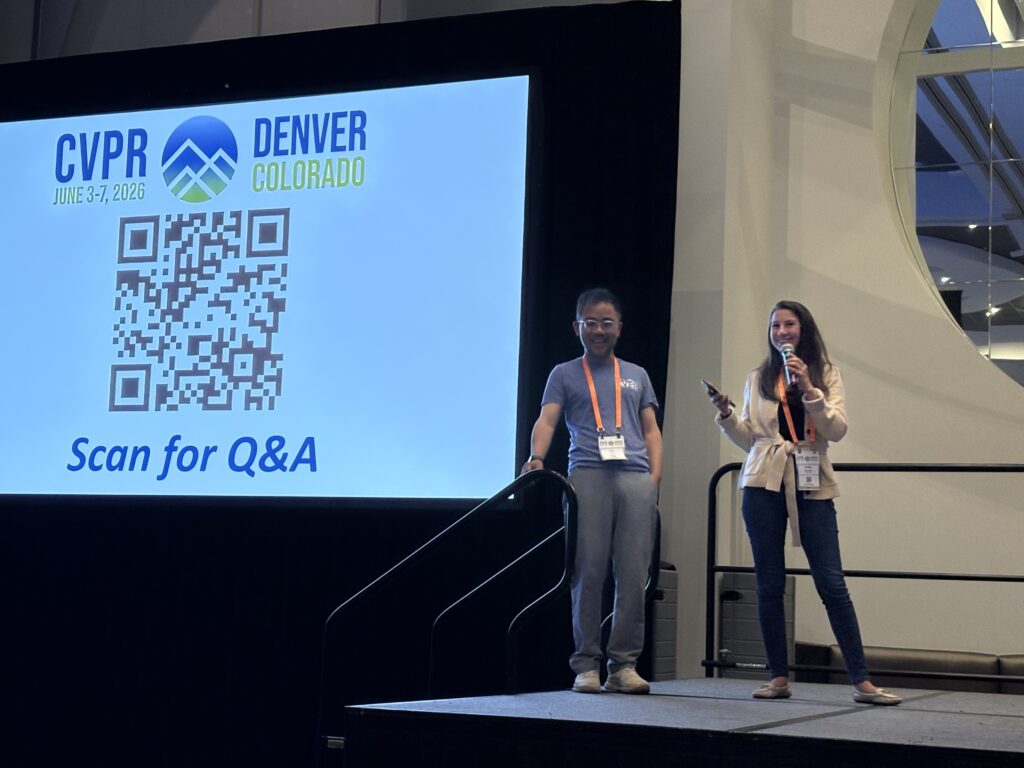
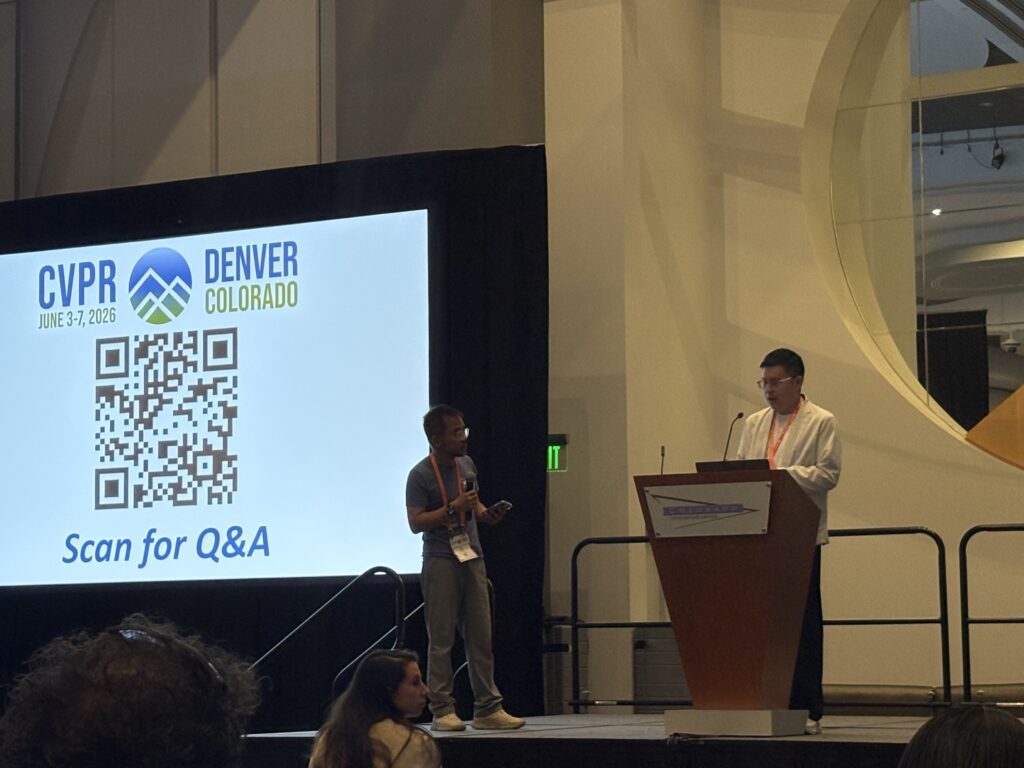
Assistant Professor Lin Gu served as the chair of the first oral session on “Computational Imaging” at Computer Vision and Pattern Recognition Conference (CVPR), the world’s premier conference on Artificial Intelligence and Computer Vision, on June 5, 2026.
He co-chaired the session with Professor Katie Bouman of the California Institute of Technology (Caltech), who led the development of the AI algorithms that enabled the first-ever image of a black hole.


June 1, 2026
Prof. Yiyu Shu from the University of Notre Dame in America gave a lecture while visiting our laboratory. The title of talk was “From Trade-offs to Talk: Enabling Speech-Driven Healthcare with LLMs”.
May 18, 2026
Dr. Xiyue Wang, a researcher at the Accessibility Lab of Miraikan (The National Museum of Emerging Science and Innovation) and a research fellow at the Interdisciplinary ICT Research Center for Cyber and Real Spaces, Research Institute of Electrical Communication, Tohoku University, gave a lecture at the DEI (Diversity, Equity, and Inclusion) seminar.
May 14, 2026
We held a welcome party!
April 16-17, 2026
Hongyue Xu and Ryo Sasaki gave oral presentations on their accepted papers at CHI 2026, a leading conference in the field of Human-Computer Interaction (HCI) research.
The presentations were as follows:
April 8-11, 2026
Assistant Professor Lin Gu participated in the IEEE International Symposium on Biomedical Imaging (held in London) and presented the latest research findings on AI for Science. This conference is one of the leading international conferences in the field of bioimaging, and many cutting-edge research projects are reported there. In this presentation, he introduced AI technology for drug discovery support utilizing electron microscope data.
The presentation covered the following two topics:
- Toward Efficient End-to-End VEM Processing Using a Unified Agent on GPUs and NPUs
He proposed an AI agent that comprehensively manages a series of processes in electron microscopy analysis (file management, stitching, registration, inpainting, slice reconstruction, etc.). Optimized for parallel processing on a GPU cloud environment, it achieves up to 10 times faster processing compared to traditional manual workflows. - Detection over Segmentation: A New Approach for Multi-Particle Picking in 3D Real-World CryoET
He proposed a new AI method for automatically detecting particles with high accuracy in cryo-electron tomography (cryo-ET) data in real-world environments. This new approach offers a balance of efficiency and accuracy, replacing conventional segmentation-based methods.
Furthermore, He gave an invited lecture at “Exploring Foundation Models in Medical Image Analysis: Applications, Challenges, and Uncertainties,” where he introduced the challenges of foundation models in the medical field and my unique approach to solving them. He also reported on the latest advances in AI analysis of brain imaging such as fMRI.
April 8, 2026
Professor Yoshifumi Kitamura received the Minister of Education, Culture, Sports, Science and Technology Award in the Science and Technology Field (Research Division) for fiscal year 2026. His achievement is titled “Research on Interactive Content Display Technology.”
To the university headquarters page
To Ministry of Education, Culture, Sports, Science and Technology page
To Research Institute of Erectircal Communication page