Enhancing User Comfort in the Metaverse
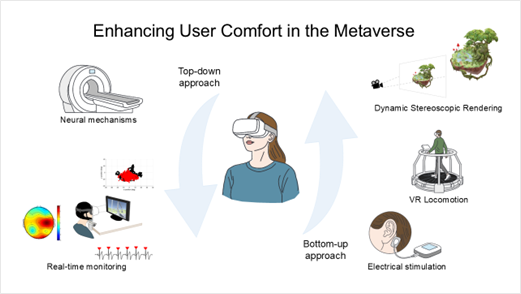
Recent studies indicate that 40% to 70% of Metaverse users experience physical discomfort, such as dizziness, eye strain, and nausea, during virtual experiences. This phenomenon is commonly known as “Cybersickness” or “VR Sickness.” We are dedicated to researching reliable methods to measure these symptoms and developing effective strategies to mitigate them to create a comfortable virtual environment for everyone. In particular, our team employs a dual strategy encompassing both top-down and bottom-up approaches. From a top-down perspective, we investigate the neural mechanisms underlying cybersickness to understand how the brain integrates and synchronizes multisensory information during VR interactions. Conversely, our bottom-up approach targets the primary sensory inputs—visual and vestibular—to directly minimize sensory conflict, thereby mitigating the level of discomfort.
Major ongoing research themes are as follows.
- Investigating Neural Mechanisms of Cybersickness using fMRI
One of the primary causes of cybersickness is sensory conflict—the mismatch between the visual information received by the eyes and the movement perceived by the vestibular system (inner ear). How does our brain process this sensory discrepancy? Furthermore, how does the brain adapt when this conflict occurs repeatedly? This project utilizes fMRI (functional Magnetic Resonance Imaging) to systematically map and identify the specific brain regions associated with cybersickness, aiming to uncover the neurological mechanisms of the problem. - Real-time Cybersickness Monitoring via Multimodal Deep Learning
While understanding the neurological mechanisms of cybersickness is fundamental, establishing a technique to detect and mitigate symptoms in real-time is equally critical. We are developing a comprehensive monitoring framework that simultaneously tracks various behavioral indicators—including head kinematics, eye movements, and facial muscle activity—during VR exposure. By analyzing this multimodal data, the system predicts user discomfort levels and can trigger immediate interventions to reduce sickness. Furthermore, our system incorporates deep learning algorithms that account for individual susceptibility, enabling precise, personalized, and robust monitoring for every user. - Dynamic Stereoscopic Rendering for Cybersickness Mitigation
Stereoscopic 3D rendering is widely adopted in Metaverse environments to simulate realistic depth perception. However, from a cybersickness perspective, continuous 3D viewing can cause significant eye strain and discomfort for users. A potential solution is to switch between 2D and 3D rendering dynamically without breaking the user’s immersion. This research investigates Dynamic Stereoscopic Rendering, a method that strategically controls visual presentation to minimize eye fatigue and sickness while maintaining a high level of presence. - Optimizing User Experience in VR Locomotion
Omni-Directional Treadmills (ODT) are becoming increasingly popular for providing immersive and engaging Metaverse experiences. In this study, we map the user’s physical steps on an ODT to virtual movement using various transfer algorithms. We analyze user satisfaction and the occurrence of sickness for each algorithm. Our goal is to identify the optimal locomotion algorithm that allows users to explore virtual worlds with maximum fun and minimum discomfort. - Reducing Sensory Conflict via Electrical Stimulation
Galvanic Vestibular Stimulation (GVS) is a non-invasive technique that applies weak electric currents to the mastoid process behind the ear to stimulate the vestibular system. Through this technique, users can feel a sensation of physical motion even when they are stationary. This research aims to use GVS to provide vestibular feedback that synchronizes with the visual movement in VR. By electrically modulating the vestibular sensation to match visual stimuli, we investigate whether this electrical intervention can effectively reduce sensory conflict and mitigate cybersickness.